Walcheren to Waterloo by Andrew Limm
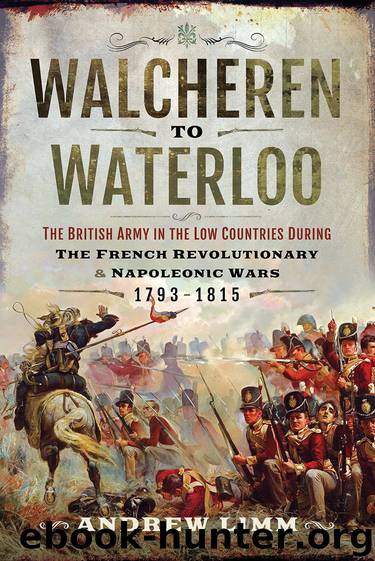
Author:Andrew Limm
Language: eng
Format: epub
Tags: HISTORY / Military / Napoleonic Wars
ISBN: 9781473874701
Publisher: Pen and Sword
Published: 2018-09-29T16:00:00+00:00
The Scheldt Inquiry: Lessons Unidentified
As the remnants of Chatham’s army struggled to survive the winter months on the disease-ridden shores of the Scheldt, the Portland government was subjected to intense political pressure amidst calls from the press for a full governmental inquiry into the expedition.221 The government had also been rocked by a personal feud between Canning and Castlereagh, the latter having caught wind of Canning’s plot to oust him at the next reshuffle.222 This rivalry was only resolved when Castlereagh fired a pistol-ball into Canning’s thigh in a duel at Putney Heath on 21 September 1809.223 Shortly afterwards the Portland government collapsed and a new Tory administration was formed under Spencer Perceval.224 Although the old leadership had made way for new, the Whigs were not satisfied and lobbied for a full public inquiry into the disaster. Despite losing an initial vote on 23 January 1810 the Whigs won a second vote in the commons three days later, thanks in part to the surprise support of Castlereagh, and it was agreed that a Committee of the Whole House would be created to conduct a formal investigation into the Scheldt expedition.225
The Inquiry opened on 2 February 1810 and was initially chaired by the former Chief Justice of Bengal and member of the Privy Council, MP Sir John Anstruther.226 In order to develop a clear picture of how the expedition had been created and conducted, the inquiry was organised in a chronological fashion, with each of the key persons being called to give evidence of their role and involvement in turn. Thus the first witness was David Dundas because he had been the first military official to have been involved in the preliminary planning process by Castlereagh.227 Over the course of the following months over forty key witnesses were interviewed by the committee drawn from both the political world and the armed forces. Howard has noted, ‘It was intended that the enquiry focus on the wider questions such as whether the expedition should have been undertaken, rather than it being a means of attaching guilt to individuals.’228 Crucially, although the committee wanted to know what had happened and why, they were not interested in identifying potential military lessons. Furthermore, the Inquiry was the result of political and press pressure and was not inspired by the military or a desire on the part of Horse Guards to learn lessons. Despite the importance of the press in generating pressure for a public inquiry the general public and press were excluded from the proceedings and the proprietors of Fleet Street were forced to publish only from official government reports.229
As the Inquiry progressed over the course of the spring its ability to conduct an objective review of the expedition was greatly undermined by the actions of Lord Chatham. Shortly after his return from Walcheren, in October 1809, Chatham had drafted a personal account of the expedition in which he heavily criticised Strachan and the Royal Navy for not forcing the West Scheldt when the fleet arrived off the coast of Walcheren.
Download
This site does not store any files on its server. We only index and link to content provided by other sites. Please contact the content providers to delete copyright contents if any and email us, we'll remove relevant links or contents immediately.
| Africa | Americas |
| Arctic & Antarctica | Asia |
| Australia & Oceania | Europe |
| Middle East | Russia |
| United States | World |
| Ancient Civilizations | Military |
| Historical Study & Educational Resources |
Room 212 by Kate Stewart(5119)
The Crown by Robert Lacey(4814)
Endurance: Shackleton's Incredible Voyage by Alfred Lansing(4780)
The Iron Duke by The Iron Duke(4354)
The Rape of Nanking by Iris Chang(4211)
Joan of Arc by Mary Gordon(4109)
Killing England by Bill O'Reilly(4001)
Say Nothing by Patrick Radden Keefe(3983)
I'll Give You the Sun by Jandy Nelson(3445)
Shadow of Night by Deborah Harkness(3366)
Hitler's Monsters by Eric Kurlander(3341)
Mary, Queen of Scots, and the Murder of Lord Darnley by Alison Weir(3210)
Blood and Sand by Alex Von Tunzelmann(3203)
Eleanor & Park by Rainbow Rowell(3169)
Darkest Hour by Anthony McCarten(3129)
Margaret Thatcher: The Autobiography by Thatcher Margaret(3081)
Book of Life by Deborah Harkness(2937)
Red Famine: Stalin's War on Ukraine by Anne Applebaum(2932)
The One Memory of Flora Banks by Emily Barr(2863)
